Noblesville, IN 46060 pairs a historic downtown of 19th-century homes with some of the fastest-growing subdivisions in Hamilton County — and its TPR valve calls reflect both worlds. In the historic district, we find aging tanks with original valves and corroded discharge piping; in the new developments, young heaters weeping from thermal expansion in closed systems with mis-charged expansion tanks. Wherever your Noblesville home falls, a dripping temperature and pressure relief valve is reporting a pressure or temperature condition that deserves a proper diagnosis, not just a new valve.
Water Heater Leak Repair Co. provides TPR valve replacement in Noblesville, IN 46060 for gas and electric tank heaters of every era. We diagnose first — pressure logged through a live heating cycle, expansion control verified, thermostat function checked — then install a correctly rated valve and bring the discharge piping up to code. Call (833) 713-2101 and tell us what your valve is doing.
In Short: In Noblesville, IN 46060, TPR valve drips come from thermal expansion in closed systems, failed or mis-charged expansion tanks, high municipal pressure, scaled seats in hard water, or aging thermostats — depending on the home's era. We diagnose pressure live, install a valve rated for your heater's BTU input, and rebuild discharge piping to a visible, code-compliant termination.
How TPR Valve Replacement Works in Noblesville, IN 46060
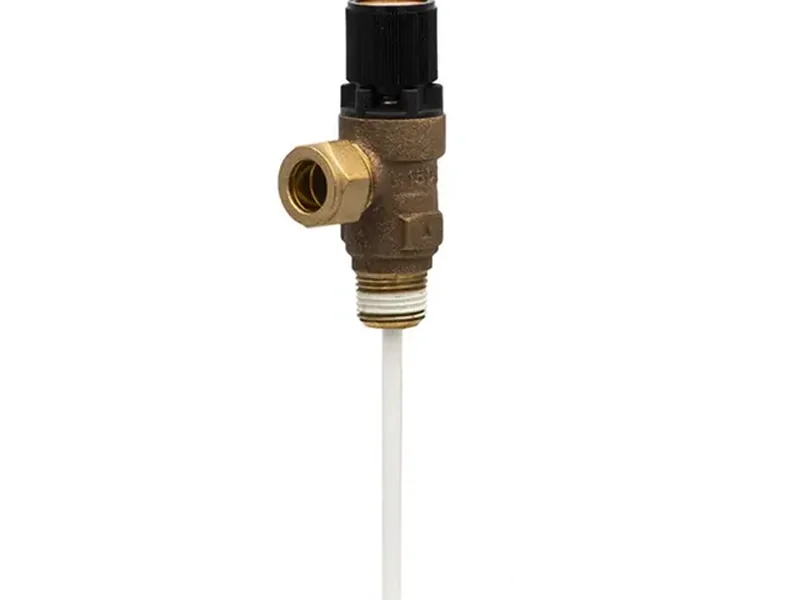
The TPR valve threads into your water heater tank and guards 150 PSI and 210°F with a spring-loaded disc and an immersed temperature probe. Our Noblesville process begins with energy off and the cold inlet closed, then controlled depressurization — followed by the diagnostic that determines the repair's durability.
We mount a gauge, record static pressure, and watch it through a full recovery cycle. Noblesville's two housing eras produce two signatures: historic-district homes often show moderate static pressure with sharp recovery spikes (closed system retrofits with no expansion tank, or original tanks with failed controls); new subdivisions show high static pressure with expansion tanks present but wrongly charged or waterlogged. The live log identifies the pattern, and the companion repair — expansion tank service, PRV adjustment, or thermostat work — follows from it.
In the historic district, we pay special attention to valve function itself. Tanks from the 1990s and earlier with original valves often have levers frozen by decades of scale; a valve that cannot open is a failed safety device regardless of appearance. We attempt the lever test during every diagnosis and show the homeowner the result. In new subdivisions, we focus on expansion tank pre-charge versus actual static pressure — the mismatch that drives most young-heater weeping.
Thermostat verification matters across both eras. Sticking thermostats on older electrics and failing gas controls on any age produce scalding discharge rather than pressure weeps — the temperature failure, and the more dangerous one. We verify cut-out temperatures and ECO function before replacing the valve.
Installation is exact: old valve extracted with a wrench on the body flats, tapping threads cleaned, new valve installed with potable-rated thread sealant. The replacement's BTU rating must meet or exceed the heater's input — verified against the data plate. On high-input gas units, correct rating is a safety requirement.
Discharge piping gets a full compliance rebuild. Code demands full-size pipe, continuous gravity pitch, no restrictions, termination 6 to 24 inches above the floor or a drain — visible. Noblesville's historic homes contribute corroded galvanized lines and missing pipes; its finished basements contribute hidden terminations behind furnaces and inside walls. During a TPR valve replacement in Noblesville, IN 46060, we correct the discharge line to standard in both settings.
We fill the tank completely before restoring energy, run a full cycle under gauge observation, confirm the new valve stays dry, exercise the test lever in front of you, and review the readings and root cause plainly.
Reading Your Valve's Pattern
Post-use weeping that fades within the hour is thermal expansion — the closed-system signature. Constant seepage with crust indicates sustained high pressure or a scaled seat. Sudden scalding discharge or steam with rumbling is temperature runaway: shut off the heater's energy and call (833) 713-2101 immediately. Note the timing before calling — it sharpens our diagnosis.
Local Factors That Matter for TPR Valves in Noblesville, IN 46060
The historic/new split is Noblesville's defining factor. Downtown's 19th- and early-20th-century homes have heaters in stone basements and tight utility spaces with decades of layered repairs — mismatched valves, creative piping, frozen levers. The subdivisions have young heaters with closed-system configuration issues. Our diagnostic adapts to the era in front of us.
White River valley water and municipal supplies carry the hardness that scales seats and stiffens springs. Annual lever tests catch frozen valves; periodic flushing removes seat-fouling sediment. In unsoftened Noblesville homes, both are routine recommendations.
Finished basements dominate the subdivisions, hiding discharge terminations behind furnaces and storage. We reroute to visible terminations and recommend water alarms at heater bases — the weep you hear about beats the one you discover in the drywall.
Growth-driven pressure zones affect static pressure across the city's expansion areas; some streets run notably higher than others. We diagnose your street's reality with the gauge, not a citywide assumption, and address the PRV when high static pressure is the driver.
The Cost of Waiting in Noblesville
A weeping valve wastes hundreds of gallons of heated water monthly — but the hidden cost is pressure damage: washing machine hoses, toilet fill valves, faucet cartridges, and the tank shell all suffer under chronic overpressure. Correcting expansion control when the valve is replaced protects the whole system, which is why our diagnostic always includes the pressure log.
Preventing the Next TPR Drip in Noblesville
Once your TPR valve is replaced and the pressure cause is corrected, keeping it healthy in Noblesville comes down to two different routines depending on your home's era. In the historic district, the annual job is the lever test — lift it briefly every spring, confirm a strong burst and a clean reseat — plus a visual check of the discharge pipe for corrosion, since stone-basement dampness eats galvanized pipe from the outside. If the lever ever feels stiff or the pipe shows flaking rust, call before it becomes a failure.
In the subdivisions, the annual job is the expansion tank: check the air charge at the Schrader valve with the system depressurized and confirm it matches your static water pressure, and give the tank the tap test — hollow ring up top, dull thud at the bottom. A tank that thuds solid throughout is waterlogged and needs replacement before the TPR valve starts weeping again. Pair that with a glance at the pressure-reducing valve's setting if you know where it is, and keep the softener fed with salt if you have one. These three small habits — lever test, expansion check, softener salt — prevent the great majority of repeat TPR service calls we see in Noblesville, in both its centuries.
What Happens When You Call (833) 713-2101
Describe the drip pattern, water temperature, heater age and fuel. Scalding discharge or steam means shutting down now with priority scheduling; a weep means a prompt visit.
On site: live pressure diagnostics, expansion and thermostat verification, old-valve function test, correctly rated replacement, compliant discharge piping, demonstrated lever test — usually one visit. You get the readings and a straight explanation of the cause and any related needs.
For TPR valve replacement in Noblesville, IN 46060, Water Heater Leak Repair Co. fixes the cause behind the drip. Call (833) 713-2101 today.