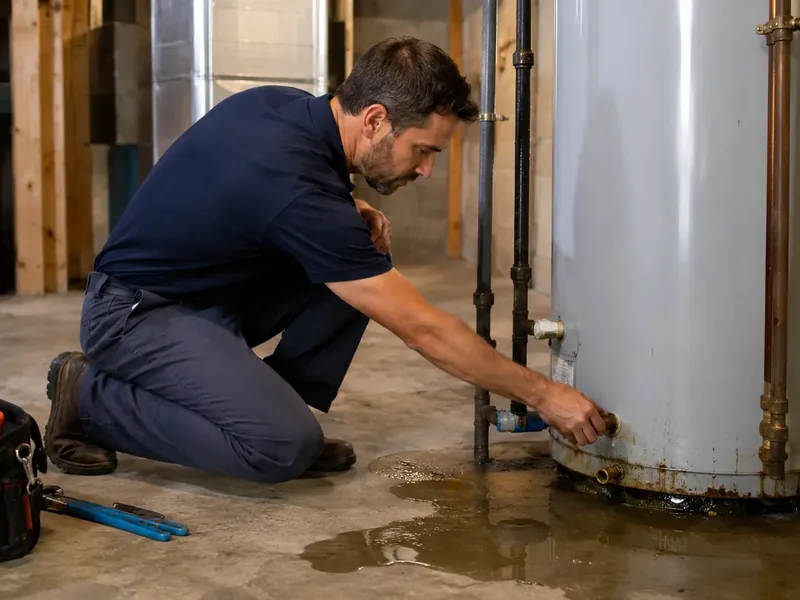
Most water heater leaks start small — a damp ring at the base, a rusty streak down the jacket, a relief valve that drips only when the burner runs. In Arcadia, those early warnings are easy to miss, especially where heaters sit in basements and utility closets. But small leaks in this part of Hamilton County rarely stay small: hard well water accelerates sediment damage. Catching the source early is the cheapest repair you'll ever buy, and missing it is the most expensive.
Arcadia is a small railroad-era town where early-1900s farmhouses and post-war bungalows sit alongside newer infill homes, with farmland and acreage properties spreading out in every direction. Homes inside town run on municipal water, but many properties just outside the town limits rely on private wells pulling hard groundwater from limestone aquifers. That's why Water Heater Leak Repair Co. treats leak detection as a diagnostic discipline, not a glance-and-guess. We pressure-test, we isolate, we meter and image — and we show you what we find before we recommend anything. If your water heater in Arcadia, IN 46030 is showing any sign of moisture, call (833) 713-2101 and get an answer instead of a worry.
In Short: If you see water around your water heater in Arcadia, IN 46030, turn off the unit's power or gas and the cold-water shutoff valve, then call Water Heater Leak Repair Co. at (833) 713-2101. We pinpoint the exact source — tank, valve, or fitting — so the right fix happens the first time.
How Water Heater Leak Detection Works in Arcadia, IN 46030
Every detection visit in Arcadia, IN 46030 follows the same disciplined sequence, because skipping steps is how leaks get misdiagnosed. We don't start with conclusions — we start with the unit shut down, the area dried, and every fitting treated as a suspect. Here's what that looks like when our technician arrives at your door:
- Moisture mapping. Pin and pinless moisture meters tell us how far dampness has traveled into the floor, walls, and baseboards, while a thermal imaging camera reveals cold tracks where water is moving behind or beneath surfaces. This map separates a heater leak from lookalikes like groundwater seepage, condensation, or a nearby plumbing drip.
- Safe shutdown and initial survey. We cut power or gas to the unit and close the cold-water shutoff, then dry the floor and jacket so fresh moisture stands out. While surfaces dry, we photograph the heater's data plate — age is the single biggest predictor of tank failure — and note the installation: venting type, pan or no pan, and where the T&P discharge terminates.
- Source confirmation and repair plan. Once the source is proven, we show you the evidence — the damp meter reading, the thermal image, the corroded fitting — and lay out the fix: a valve or fitting replacement, or a full tank replacement if the vessel itself has failed. No pressure, just the facts and a clear next step.
- Fitting-by-fitting inspection. We work top to bottom: cold and hot connections and dielectric unions, the anode rod port, the temperature-and-pressure relief valve and its discharge pipe, the drain valve, and finally the tank seams and base. Corrosion crust, mineral trails, and rust streaks each point to a specific source — we read them like a trail.
- Condensation vs. leak verdict. Cold incoming water in winter can sweat on the tank and burner area, mimicking a leak. We verify with temperature readings and timed observation: true leaks persist and leave mineral evidence; condensation dries and returns with conditions. You get a straight answer, not a shrug.
- Isolation and pressure testing. When the source still isn't obvious, we isolate sections — closing valves, capping lines, and watching the pressure gauge — to prove whether the tank itself holds pressure. On gas units we also check whether the leak only appears during a heating cycle, which points to expansion-related weeping at the T&P valve.
The whole visit typically takes under an hour, and it ends the uncertainty that keeps Arcadia homeowners mopping the same spot every morning. Whether the answer is a low-cost part or a new tank, knowing beats guessing — call (833) 713-2101 and we'll find it.
Arcadia's Local Factors: Water, Homes, and Climate in 46030
Well water on the outskirts of Arcadia tends to be very hard, which accelerates sediment buildup inside tanks. Older farmhouses often still have galvanized supply nipples that corrode from the inside out, creating leak points at the top of the tank that are easy to mistake for tank failure. Beyond that, Arcadia adds its own wrinkles. Arcadia is a small railroad-era town where early-1900s farmhouses and post-war bungalows sit alongside newer infill homes, with farmland and acreage properties spreading out in every direction. Around Arcadia we find water heaters in basements of the older homes, in utility closets of ranch houses, and occasionally in garages or outbuildings on acreage properties. Each of those details changes how leaks behave and where they hide:
- Installation location decides how fast you notice. Around Arcadia we find water heaters in basements of the older homes, in utility closets of ranch houses, and occasionally in garages or outbuildings on acreage properties. A leak in a lived-in basement gets spotted in a day; a leak in a crawlspace or behind a furnace can run for months, rotting framing and feeding mold the whole time.
- High water tables and damp basements confuse the picture. Homes inside town run on municipal water, but many properties just outside the town limits rely on private wells pulling hard groundwater from limestone aquifers. In low-lying parts of Arcadia, groundwater seepage and tank leaks look identical at first glance. Our moisture mapping exists precisely to tell them apart before anyone spends money on the wrong fix.
- Freeze-thaw cycles punish weak points. Central Indiana winters swing hard, and Many Arcadia-area homes still heat with older atmospheric-vent gas units tucked into basement corners with limited clearance. When water inside a compromised fitting freezes and expands, a seep becomes a split. We see a spike in leak calls every January and February for exactly this reason.
- Hard water works against tanks here. Homes inside town run on municipal water, but many properties just outside the town limits rely on private wells pulling hard groundwater from limestone aquifers. Dissolved minerals settle into sediment that insulates the bottom of the tank, forcing the burner or elements to overheat the steel. Overheated steel stresses seams and welds — and stressed seams are where tanks let go.
- Aging infrastructure multiplies suspects. Arcadia is a small railroad-era town where early-1900s farmhouses and post-war bungalows sit alongside newer infill homes, with farmland and acreage properties spreading out in every direction. Older supply nipples, original shutoff valves, and decades-old dielectric unions corrode from the inside — and every corroded joint is a potential leak that has nothing to do with the tank itself.
One Arcadia-specific note before you call: Many Arcadia-area homes still heat with older atmospheric-vent gas units tucked into basement corners with limited clearance.
Warning Signs Arcadia Homeowners Shouldn't Ignore
Your water heater usually warns you before it fails. In Arcadia homes, these are the warnings we take most seriously — if you recognize any of them, don't wait for the puddle to grow:
- A T&P valve that drips or discharges. The temperature-and-pressure relief valve should never leak under normal conditions. Dripping means excess pressure, excess temperature, or a failed valve — all worth immediate attention.
- Rusty or discolored hot water. When only the hot water runs rusty, the inside of the tank is corroding. That corrosion eventually breaches the steel, and the breach becomes a leak.
- Rust streaks down the jacket. Orange-brown trails running down the tank's exterior trace back to a specific leak point above. Follow the streak upward and you'll usually find the culprit: a fitting, the anode port, or a seam.
- A pilot that won't stay lit (gas units). Water dripping onto the burner assembly can snuff the pilot. If your pilot keeps going out and the area looks damp, suspect a leak above the burner.
- Water pooling at the base. The classic sign. Even a thin ring of dampness around the tank's footprint means water is escaping somewhere — and base pooling is the signature of a failing tank seam.
- Warm spots on the floor nearby. Hot water leaking under a slab or into flooring materials leaves warm patches you can feel with a bare foot — a subtle clue that catches slow leaks early.
What Happens When You Call Water Heater Leak Repair Co.
No phone trees, no pushy sales visit — here's exactly what happens when Arcadia homeowners call (833) 713-2101:
- 1. You describe what you're seeing. Water on the floor, a rusty streak, a hissing sound — whatever tipped you off. We'll ask a few quick questions about the heater's age and location, then schedule the visit, often the same day in Arcadia.
- 2. We find the true source. Our technician runs the full detection sequence — meters, thermal imaging, fitting-by-fitting inspection — and shows you the evidence. You'll know whether it's the tank, a valve, or a connection before we discuss any repair.
- 3. You get a straight recommendation. Fitting or valve issue? We fix it on the spot in most cases. Tank failure? We'll explain replacement options honestly, including what code requires. Either way, the leak stops and you understand why.
Stop mopping and start knowing. One call to Water Heater Leak Repair Co. at (833) 713-2101 brings a trained technician to your Arcadia home with the instruments to prove exactly what's leaking and the parts to fix most fitting and valve leaks on the spot. Arcadia, IN 46030 — we're already nearby.