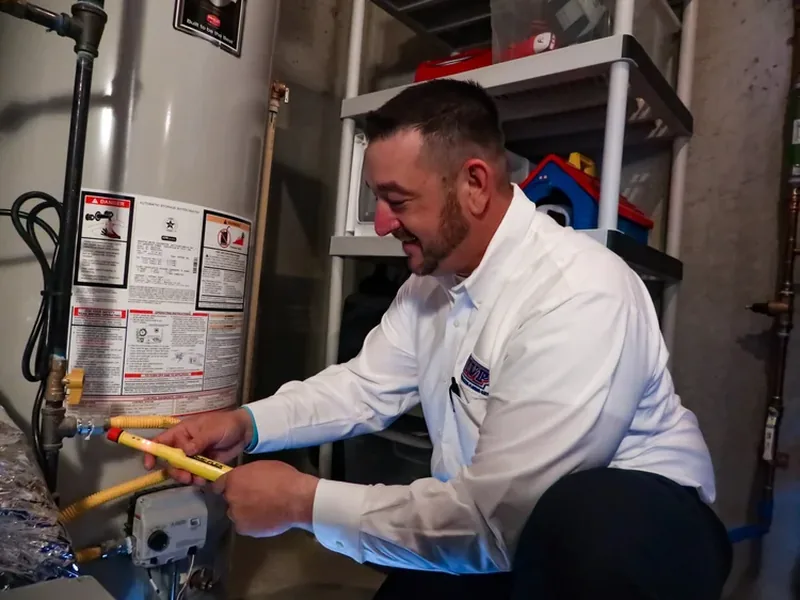
A puddle beside your water heater is never "just condensation" until someone proves it. In Fishers homes, we trace leaks back to failed tank seams, weeping temperature-and-pressure relief valves, corroded dielectric unions, and drain valves that never fully sealed — and each source calls for a completely different fix. Guessing wrong means replacing a tank that only needed a fitting, or patching a fitting on a tank that is already failing. Our leak detection process exists to remove the guesswork: we shut the unit down safely, map every damp spot with moisture meters and thermal imaging, and inspect the heater fitting by fitting until the true source shows itself.
Fishers has boomed into a large, affluent suburb northeast of Indianapolis, with Geist Reservoir to the east and big two-story family homes across master-planned neighborhoods. Municipal water serves Fishers homes; it is moderately hard central Indiana water that builds sediment in hardworking family tanks. Fishers heaters typically sit in basement utility rooms — frequently next to finished basements — or in garages in slab sections. That local mix shapes where Fishers leaks hide and how fast they cause damage, which is why a detection visit here is never a five-minute glance. When you call Water Heater Leak Repair Co. at (833) 713-2101, you get a technician who finds the actual source — tank, valve, or connection — and tells you plainly what it will take to stop it.
In Short: Water pooling by your heater in 46038? Shut off power or gas and the cold-water valve, then call Water Heater Leak Repair Co. at (833) 713-2101. Our Fishers technicians trace the leak to its true source with meters and thermal imaging.
How Water Heater Leak Detection Works in Fishers, IN 46038
Every detection visit in Fishers, IN 46038 follows the same disciplined sequence, because skipping steps is how leaks get misdiagnosed. We don't start with conclusions — we start with the unit shut down, the area dried, and every fitting treated as a suspect. Here's what that looks like when our technician arrives at your door:
- Safe shutdown and initial survey. We cut power or gas to the unit and close the cold-water shutoff, then dry the floor and jacket so fresh moisture stands out. While surfaces dry, we photograph the heater's data plate — age is the single biggest predictor of tank failure — and note the installation: venting type, pan or no pan, and where the T&P discharge terminates.
- Fitting-by-fitting inspection. We work top to bottom: cold and hot connections and dielectric unions, the anode rod port, the temperature-and-pressure relief valve and its discharge pipe, the drain valve, and finally the tank seams and base. Corrosion crust, mineral trails, and rust streaks each point to a specific source — we read them like a trail.
- Moisture mapping. Pin and pinless moisture meters tell us how far dampness has traveled into the floor, walls, and baseboards, while a thermal imaging camera reveals cold tracks where water is moving behind or beneath surfaces. This map separates a heater leak from lookalikes like groundwater seepage, condensation, or a nearby plumbing drip.
- Condensation vs. leak verdict. Cold incoming water in winter can sweat on the tank and burner area, mimicking a leak. We verify with temperature readings and timed observation: true leaks persist and leave mineral evidence; condensation dries and returns with conditions. You get a straight answer, not a shrug.
- Isolation and pressure testing. When the source still isn't obvious, we isolate sections — closing valves, capping lines, and watching the pressure gauge — to prove whether the tank itself holds pressure. On gas units we also check whether the leak only appears during a heating cycle, which points to expansion-related weeping at the T&P valve.
- Source confirmation and repair plan. Once the source is proven, we show you the evidence — the damp meter reading, the thermal image, the corroded fitting — and lay out the fix: a valve or fitting replacement, or a full tank replacement if the vessel itself has failed. No pressure, just the facts and a clear next step.
That's the complete process, and it's the same whether your heater sits basement utility rooms and garages or anywhere else in 46038. One visit, one proven source, one honest recommendation — that's what (833) 713-2101 gets you.
Fishers's Local Factors: Water, Homes, and Climate in 46038
Big households mean big hot-water demand, and Fishers tanks work hard: heavy use plus moderately hard water equals fast sediment buildup and shorter tank life. With so many finished basements, we always evaluate leak containment — a pan, a drain, and an alarm — on every visit. Beyond that, Fishers adds its own wrinkles. Fishers has boomed into a large, affluent suburb northeast of Indianapolis, with Geist Reservoir to the east and big two-story family homes across master-planned neighborhoods. Fishers heaters typically sit in basement utility rooms — frequently next to finished basements — or in garages in slab sections. Each of those details changes how leaks behave and where they hide:
- Hard water works against tanks here. Municipal water serves Fishers homes; it is moderately hard central Indiana water that builds sediment in hardworking family tanks. Dissolved minerals settle into sediment that insulates the bottom of the tank, forcing the burner or elements to overheat the steel. Overheated steel stresses seams and welds — and stressed seams are where tanks let go.
- Freeze-thaw cycles punish weak points. Central Indiana winters swing hard, and Many Fishers homes run 50-gallon or larger units to keep up with multiple bathrooms, and those bigger tanks hold more water when they fail. When water inside a compromised fitting freezes and expands, a seep becomes a split. We see a spike in leak calls every January and February for exactly this reason.
- Installation location decides how fast you notice. Fishers heaters typically sit in basement utility rooms — frequently next to finished basements — or in garages in slab sections. A leak in a lived-in basement gets spotted in a day; a leak in a crawlspace or behind a furnace can run for months, rotting framing and feeding mold the whole time.
- High water tables and damp basements confuse the picture. Municipal water serves Fishers homes; it is moderately hard central Indiana water that builds sediment in hardworking family tanks. In low-lying parts of Fishers, groundwater seepage and tank leaks look identical at first glance. Our moisture mapping exists precisely to tell them apart before anyone spends money on the wrong fix.
- Aging infrastructure multiplies suspects. Fishers has boomed into a large, affluent suburb northeast of Indianapolis, with Geist Reservoir to the east and big two-story family homes across master-planned neighborhoods. Older supply nipples, original shutoff valves, and decades-old dielectric unions corrode from the inside — and every corroded joint is a potential leak that has nothing to do with the tank itself.
What makes Fishers distinct here: Many Fishers homes run 50-gallon or larger units to keep up with multiple bathrooms, and those bigger tanks hold more water when they fail.
Warning Signs Fishers Homeowners Shouldn't Ignore
Your water heater usually warns you before it fails. In Fishers homes, these are the warnings we take most seriously — if you recognize any of them, don't wait for the puddle to grow:
- Water pooling at the base. The classic sign. Even a thin ring of dampness around the tank's footprint means water is escaping somewhere — and base pooling is the signature of a failing tank seam.
- Musty smells near the heater. Persistent dampness behind or under the unit feeds mold and mildew. If the utility area smells musty and you can't find the moisture, the heater is a prime suspect.
- Rust streaks down the jacket. Orange-brown trails running down the tank's exterior trace back to a specific leak point above. Follow the streak upward and you'll usually find the culprit: a fitting, the anode port, or a seam.
- Warm spots on the floor nearby. Hot water leaking under a slab or into flooring materials leaves warm patches you can feel with a bare foot — a subtle clue that catches slow leaks early.
- A pilot that won't stay lit (gas units). Water dripping onto the burner assembly can snuff the pilot. If your pilot keeps going out and the area looks damp, suspect a leak above the burner.
- Rusty or discolored hot water. When only the hot water runs rusty, the inside of the tank is corroding. That corrosion eventually breaches the steel, and the breach becomes a leak.
What Happens When You Call Water Heater Leak Repair Co.
No phone trees, no pushy sales visit — here's exactly what happens when Fishers homeowners call (833) 713-2101:
- 1. You describe what you're seeing. Water on the floor, a rusty streak, a hissing sound — whatever tipped you off. We'll ask a few quick questions about the heater's age and location, then schedule the visit, often the same day in Fishers.
- 2. We find the true source. Our technician runs the full detection sequence — meters, thermal imaging, fitting-by-fitting inspection — and shows you the evidence. You'll know whether it's the tank, a valve, or a connection before we discuss any repair.
- 3. You get a straight recommendation. Fitting or valve issue? We fix it on the spot in most cases. Tank failure? We'll explain replacement options honestly, including what code requires. Either way, the leak stops and you understand why.
A leaking water heater doesn't fix itself, and in Fishers it doesn't stay small for long. Every day of seepage is another day of damage to floors, walls, and whatever sits near that heater. Call Water Heater Leak Repair Co. at (833) 713-2101 now — we'll find the source, stop the leak, and give you back a dry floor. Serving Fishers, IN 46038 and the surrounding Hamilton County communities.