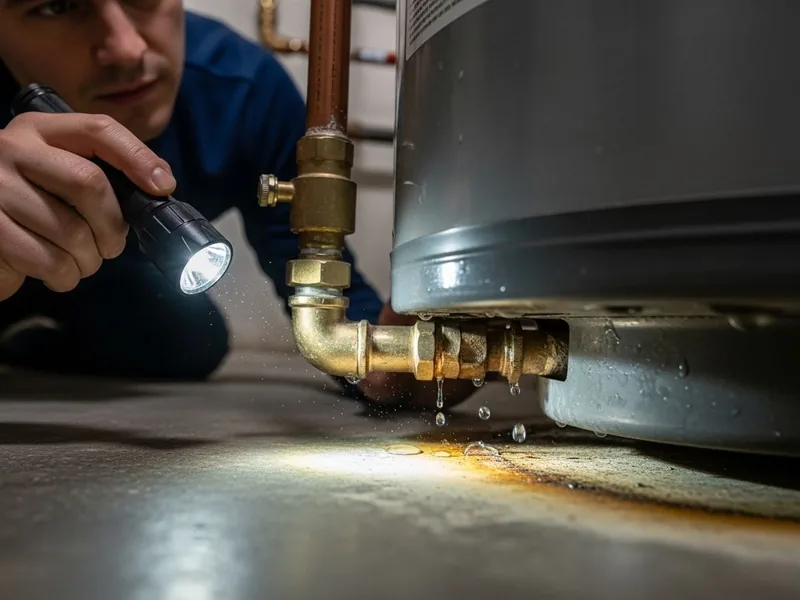
Most water heater leaks start small — a damp ring at the base, a rusty streak down the jacket, a relief valve that drips only when the burner runs. In McCordsville, those early warnings are easy to miss, especially where heaters sit in garages on slabs. But small leaks in this part of Hancock County rarely stay small: a wave of original tanks is aging out together. Catching the source early is the cheapest repair you'll ever buy, and missing it is the most expensive.
McCordsville is one of the region's fastest-growing towns, with new subdivisions spreading along the Mt. Comfort Road corridor and nearly all housing stock dating from the 1990s onward. Municipal water serves the town's subdivisions; moderately hard, like the rest of central Indiana. That's why Water Heater Leak Repair Co. treats leak detection as a diagnostic discipline, not a glance-and-guess. We pressure-test, we isolate, we meter and image — and we show you what we find before we recommend anything. If your water heater in McCordsville, IN 46055 is showing any sign of moisture, call (833) 713-2101 and get an answer instead of a worry.
In Short: Don't guess about a leaking water heater in McCordsville. Turn off the power or gas, close the cold-water valve, and call Water Heater Leak Repair Co. at (833) 713-2101. We find whether the tank, a valve, or a fitting is leaking — then fix it correctly.
How Water Heater Leak Detection Works in McCordsville, IN 46055
Leak detection is detective work with instruments. Water follows gravity, wicks through drywall, and evaporates before you see it, so eyeballing a puddle tells you almost nothing about where it began. Our process works from the outside in: first we make the area safe and dry the surfaces, then we map moisture, then we test each suspect component under controlled conditions. In McCordsville, that methodical approach matters because McCordsville's homes are young, but their water heaters are hitting middle age together: the big 2000s building wave means thousands of original tanks are now 15–20 years old. We see waves of simultaneous failures in the same subdivisions.
- Source confirmation and repair plan. Once the source is proven, we show you the evidence — the damp meter reading, the thermal image, the corroded fitting — and lay out the fix: a valve or fitting replacement, or a full tank replacement if the vessel itself has failed. No pressure, just the facts and a clear next step.
- Moisture mapping. Pin and pinless moisture meters tell us how far dampness has traveled into the floor, walls, and baseboards, while a thermal imaging camera reveals cold tracks where water is moving behind or beneath surfaces. This map separates a heater leak from lookalikes like groundwater seepage, condensation, or a nearby plumbing drip.
- Condensation vs. leak verdict. Cold incoming water in winter can sweat on the tank and burner area, mimicking a leak. We verify with temperature readings and timed observation: true leaks persist and leave mineral evidence; condensation dries and returns with conditions. You get a straight answer, not a shrug.
- Safe shutdown and initial survey. We cut power or gas to the unit and close the cold-water shutoff, then dry the floor and jacket so fresh moisture stands out. While surfaces dry, we photograph the heater's data plate — age is the single biggest predictor of tank failure — and note the installation: venting type, pan or no pan, and where the T&P discharge terminates.
- Isolation and pressure testing. When the source still isn't obvious, we isolate sections — closing valves, capping lines, and watching the pressure gauge — to prove whether the tank itself holds pressure. On gas units we also check whether the leak only appears during a heating cycle, which points to expansion-related weeping at the T&P valve.
- Fitting-by-fitting inspection. We work top to bottom: cold and hot connections and dielectric unions, the anode rod port, the temperature-and-pressure relief valve and its discharge pipe, the drain valve, and finally the tank seams and base. Corrosion crust, mineral trails, and rust streaks each point to a specific source — we read them like a trail.
That's the complete process, and it's the same whether your heater sits garages on slabs or anywhere else in 46055. One visit, one proven source, one honest recommendation — that's what (833) 713-2101 gets you.
McCordsville's Local Factors: Water, Homes, and Climate in 46055
McCordsville's homes are young, but their water heaters are hitting middle age together: the big 2000s building wave means thousands of original tanks are now 15–20 years old. We see waves of simultaneous failures in the same subdivisions. Beyond that, McCordsville adds its own wrinkles. McCordsville is one of the region's fastest-growing towns, with new subdivisions spreading along the Mt. Comfort Road corridor and nearly all housing stock dating from the 1990s onward. Garage installs on slab foundations are the McCordsville standard, with some basement utility rooms in two-story models. Each of those details changes how leaks behave and where they hide:
- Freeze-thaw cycles punish weak points. Central Indiana winters swing hard, and Slab-on-grade garage installs dominate here, so pan drains and alarms are the main defense against a leak spreading across the slab. When water inside a compromised fitting freezes and expands, a seep becomes a split. We see a spike in leak calls every January and February for exactly this reason.
- Installation location decides how fast you notice. Garage installs on slab foundations are the McCordsville standard, with some basement utility rooms in two-story models. A leak in a lived-in basement gets spotted in a day; a leak in a crawlspace or behind a furnace can run for months, rotting framing and feeding mold the whole time.
- High water tables and damp basements confuse the picture. Municipal water serves the town's subdivisions; moderately hard, like the rest of central Indiana. In low-lying parts of McCordsville, groundwater seepage and tank leaks look identical at first glance. Our moisture mapping exists precisely to tell them apart before anyone spends money on the wrong fix.
- Aging infrastructure multiplies suspects. McCordsville is one of the region's fastest-growing towns, with new subdivisions spreading along the Mt. Comfort Road corridor and nearly all housing stock dating from the 1990s onward. Older supply nipples, original shutoff valves, and decades-old dielectric unions corrode from the inside — and every corroded joint is a potential leak that has nothing to do with the tank itself.
- Hard water works against tanks here. Municipal water serves the town's subdivisions; moderately hard, like the rest of central Indiana. Dissolved minerals settle into sediment that insulates the bottom of the tank, forcing the burner or elements to overheat the steel. Overheated steel stresses seams and welds — and stressed seams are where tanks let go.
One McCordsville-specific note before you call: Slab-on-grade garage installs dominate here, so pan drains and alarms are the main defense against a leak spreading across the slab.
Warning Signs McCordsville Homeowners Shouldn't Ignore
Leaks rarely arrive unannounced. Here's what McCordsville homeowners describe on the call that brings us out — and what each symptom usually means:
- Water pooling at the base. The classic sign. Even a thin ring of dampness around the tank's footprint means water is escaping somewhere — and base pooling is the signature of a failing tank seam.
- Musty smells near the heater. Persistent dampness behind or under the unit feeds mold and mildew. If the utility area smells musty and you can't find the moisture, the heater is a prime suspect.
- Rusty or discolored hot water. When only the hot water runs rusty, the inside of the tank is corroding. That corrosion eventually breaches the steel, and the breach becomes a leak.
- Rumbling, popping, or banging. Those sounds are sediment-choked water boiling at the bottom of the tank. Heavy sediment overheats the steel and shortens tank life dramatically — it's the soundtrack of a future leak.
- A pilot that won't stay lit (gas units). Water dripping onto the burner assembly can snuff the pilot. If your pilot keeps going out and the area looks damp, suspect a leak above the burner.
- Warm spots on the floor nearby. Hot water leaking under a slab or into flooring materials leaves warm patches you can feel with a bare foot — a subtle clue that catches slow leaks early.
What Happens When You Call Water Heater Leak Repair Co.
No phone trees, no pushy sales visit — here's exactly what happens when McCordsville homeowners call (833) 713-2101:
- 1. You describe what you're seeing. Water on the floor, a rusty streak, a hissing sound — whatever tipped you off. We'll ask a few quick questions about the heater's age and location, then schedule the visit, often the same day in McCordsville.
- 2. We find the true source. Our technician runs the full detection sequence — meters, thermal imaging, fitting-by-fitting inspection — and shows you the evidence. You'll know whether it's the tank, a valve, or a connection before we discuss any repair.
- 3. You get a straight recommendation. Fitting or valve issue? We fix it on the spot in most cases. Tank failure? We'll explain replacement options honestly, including what code requires. Either way, the leak stops and you understand why.
Stop mopping and start knowing. One call to Water Heater Leak Repair Co. at (833) 713-2101 brings a trained technician to your McCordsville home with the instruments to prove exactly what's leaking and the parts to fix most fitting and valve leaks on the spot. McCordsville, IN 46055 — we're already nearby.