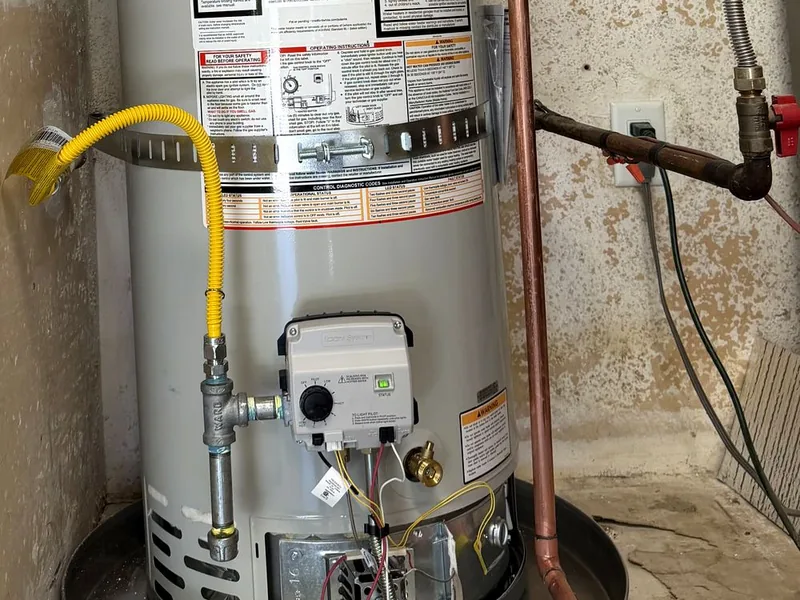
Think of a drain pan as flood protection you install once. The pan itself is inexpensive; the damage it prevents is not. In Cicero, where crawlspaces and utility closets, a pan under the heater is the difference between mopping up a contained leak and tearing out drywall, flooring, and baseboards. Indiana's residential plumbing code agrees: pans are required wherever a water heater leak would damage the structure — which covers most Hamilton County homes with heaters over finished space.
Cicero sits at the north end of Morse Reservoir, mixing original lake cottages and modest ranch homes with newer construction drawn by waterfront living. Crawlspace installations near Morse Reservoir are the local challenge: high water tables keep these spaces damp, which accelerates corrosion on tank bases and fittings. A leak in a Cicero crawlspace can go unnoticed for months, and we bring the lighting and inspection tools to check what homeowners can't easily see. When Water Heater Leak Repair Co. installs a pan in Cicero, IN 46034, we do the complete job: shut down and drain the unit, lift it onto a correctly sized corrosion-resistant pan, reconnect everything, run the drain line to an approved termination, and test the whole assembly. One visit, lasting protection. Call (833) 713-2101 to schedule yours.
In Short: If your water heater in Cicero, IN 46034 sits over finished space with no drain pan beneath it, call Water Heater Leak Repair Co. at (833) 713-2101. We install code-ready, corrosion-resistant pans with proper drain lines — usually in a single visit.
How Water Heater Pan Installation Works in Cicero, IN 46034
Installing a pan isn't just sliding a tray under the tank — the heater has to come off its footprint, the pan has to be sized and leveled, and the drain line has to actually go somewhere useful. In Cicero, that last part is where most DIY and shortcut installs fail: a pan with no drain, or a drain that terminates six inches from the foundation, is decoration. Here's our complete process:
- Disconnect and lift. Water lines, gas or electrical connections, and venting are disconnected, and the tank is lifted clear of its footprint. This is also when we inspect the floor beneath: soft subfloor or old water stains tell us the heater has been weeping unnoticed.
- Location and code assessment. We confirm the heater actually needs a pan — code requires one where leakage would cause damage, which includes finished basements, living-space closets, and installations above ceilings. We also map where the drain line can legally terminate: a floor drain, an indirect waste receptor, or the building exterior.
- Reconnect and drain line installation. The heater goes back onto the pan, connections are remade with fresh supply lines and a new shutoff valve where needed, and a full-size drain line is run from the pan to the approved termination — pitched continuously so it drains by gravity, with no traps or uphill runs.
- Water alarm, refill, and testing. We recommend a battery water alarm in the pan — a low-cost device that sounds an alert when water touches it — then refill the tank, purge air from the lines, restore power or relight the pilot, and verify the drain path flows freely with a test pour.
- Safe shutdown and drain-down. Power or gas off, cold-water supply closed, and the tank drained through a hose to a safe discharge point. We check the drain valve's condition as we go — old plastic drain valves often need replacement before they'll flow.
- Pan placement and leveling. We set a corrosion-resistant pan — aluminum or heavy-duty plastic, never a material that will rust out — sized at least two inches wider in diameter than the tank, leveled so water flows toward the drain outlet rather than pooling in a corner.
Start to finish, most Cicero pan installations are done in two to four hours, and you get a heater that can fail without flooding your home. Call (833) 713-2101 — it's the cheapest damage prevention in your house.
Warning Signs Cicero Homeowners Shouldn't Ignore
Not sure whether your heater needs a pan? In Cicero, these situations mean the answer is yes:
- Your floor shows old water stains. Stains under or around the heater mean it has leaked before, quietly. A pan plus a water alarm makes sure the next one announces itself.
- You've had a leak before. A previous weep or flood is proof of the risk. Adding a pan after the first incident is the definition of closing the barn door — but the second incident is usually worse.
- There's no pan at all. Peek under your heater: bare concrete, wood, or flooring with no tray means zero containment. This is the most common thing we find in Cicero.
- The heater is above a living area. Upstairs utility closets put 40–50 gallons directly over ceilings and floors below. In these installs a pan isn't optional in any practical sense.
- There's a pan but no drain line. A tray with nowhere to drain just delays the flood by a few gallons. If your pan has no drain — or a drain that goes nowhere — the job was never finished.
- Your heater sits over finished space. Finished basement, living-room closet, laundry room with finished floors — if a leak would damage finishes, code requires a pan and you need the protection regardless.
Cicero's Local Factors: Water, Homes, and Climate in 46034
Crawlspace installations near Morse Reservoir are the local challenge: high water tables keep these spaces damp, which accelerates corrosion on tank bases and fittings. A leak in a Cicero crawlspace can go unnoticed for months, and we bring the lighting and inspection tools to check what homeowners can't easily see. The local picture fills in from there. Cicero sits at the north end of Morse Reservoir, mixing original lake cottages and modest ranch homes with newer construction drawn by waterfront living. Many Cicero homes have crawlspaces rather than full basements, so heaters often sit in low-clearance crawlspaces or small utility closets. Here's how those Cicero realities shape pan decisions:
- Finished basements demand pans. Cicero sits at the north end of Morse Reservoir, mixing original lake cottages and modest ranch homes with newer construction drawn by waterfront living. Wherever a heater sits above or beside finished living space, code requires a pan — and common sense requires a drain line that works. We size and route for the actual risk, not the minimum.
- Crawlspaces need pans most and get them least. Many Cicero homes have crawlspaces rather than full basements, so heaters often sit in low-clearance crawlspaces or small utility closets. A leak in a crawlspace can run for months unseen. A pan with an alarm in these installs is the only early warning you'll get.
- Older homes never had them. Cicero sits at the north end of Morse Reservoir, mixing original lake cottages and modest ranch homes with newer construction drawn by waterfront living. Many Cicero heaters are replacements sitting where the original unit sat — on bare floor, because pans weren't standard when the house was built. Every replacement is a second chance to add one.
- Garage slabs hide leaks. Many Cicero homes have crawlspaces rather than full basements, so heaters often sit in low-clearance crawlspaces or small utility closets. On a slab, leaked water doesn't pool visibly — it runs under walls and into adjacent rooms. A pan with an exterior drain termination catches it at the source instead.
- Hard water shortens the fuse. Town water serves the core, while homes farther out use private wells; either way, the reservoir-area water table runs high. Sediment-choked tanks fail sooner and more suddenly. In Cicero, a pan isn't pessimism — it's planning for a timeline you can roughly predict.
What makes Cicero distinct for pans: Older lake cottages around Cicero sometimes have heaters shoehorned into additions with difficult access.
What Happens When You Call Water Heater Leak Repair Co.
No phone trees, no pushy sales visit — here's exactly what happens when Cicero homeowners call (833) 713-2101:
- 1. We assess your heater's location. Tell us where your heater sits — basement, garage, closet — and whether there's a pan now. We'll confirm what code requires for that location and quote the complete job: pan, drain line, and alarm option.
- 2. We install it in one visit. Our technician shuts down, drains, lifts, and sets your heater onto a properly sized corrosion-resistant pan, then runs the drain line to an approved termination. Most Cicero installs finish in a few hours.
- 3. You get lasting protection. We test the drain path, set the water alarm if you chose one, and walk you through what to watch for. The next tank failure becomes a cleanup instead of a catastrophe.
Don't wait for the flood to discover your heater has no pan. One call to Water Heater Leak Repair Co. at (833) 713-2101 gets your Cicero home a code-ready pan installation — sized right, drained right, tested, and done in a single visit. Cicero, IN 46034: protect the floors before the tank fails.