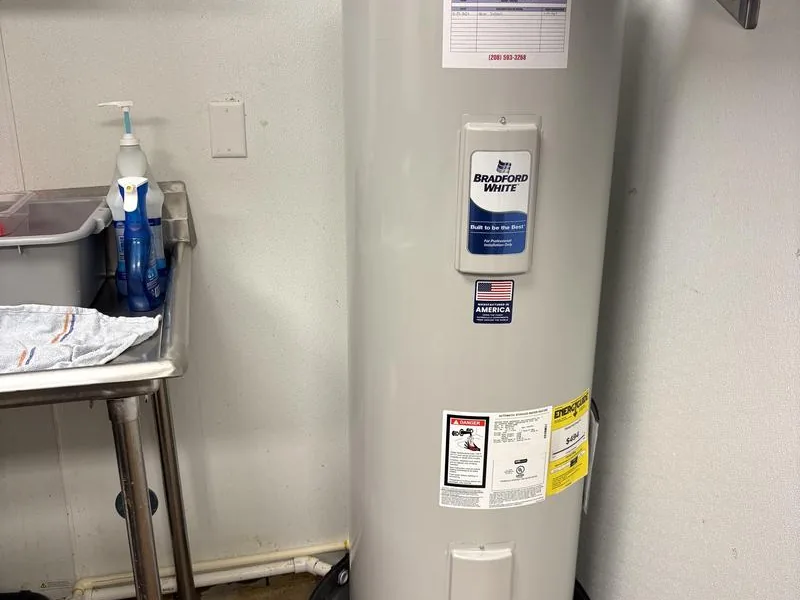
A water heater holds 40 to 50 gallons, and when a tank lets go, every one of those gallons heads for your floor. A drain pan — a simple corrosion-resistant tray under the heater with a drain line routed to safety — is what stands between a failed tank and a ruined basement. Indiana's residential plumbing code requires a pan anywhere a leak would cause damage: over finished spaces, in living-area closets, and above ceilings. Yet across McCordsville, we find heaters sitting directly on concrete, wood, and finished flooring with nothing beneath them, one seam failure away from a very expensive day.
McCordsville is one of the region's fastest-growing towns, with new subdivisions spreading along the Mt. Comfort Road corridor and nearly all housing stock dating from the 1990s onward. Garage installs on slab foundations are the McCordsville standard, with some basement utility rooms in two-story models. That combination is exactly why pan installation matters here. Water Heater Leak Repair Co. installs properly sized pans with full-size drain lines terminated where code requires — not just a tray, but a working drainage path. Call us at (833) 713-2101 and we'll assess your heater's location in McCordsville, IN 46055 and install the protection it should have had from day one.
In Short: If your water heater in McCordsville, IN 46055 sits over finished space with no drain pan beneath it, call Water Heater Leak Repair Co. at (833) 713-2101. We install code-ready, corrosion-resistant pans with proper drain lines — usually in a single visit.
How Water Heater Pan Installation Works in McCordsville, IN 46055
Installing a pan isn't just sliding a tray under the tank — the heater has to come off its footprint, the pan has to be sized and leveled, and the drain line has to actually go somewhere useful. In McCordsville, that last part is where most DIY and shortcut installs fail: a pan with no drain, or a drain that terminates six inches from the foundation, is decoration. Here's our complete process:
- Water alarm, refill, and testing. We recommend a battery water alarm in the pan — a low-cost device that sounds an alert when water touches it — then refill the tank, purge air from the lines, restore power or relight the pilot, and verify the drain path flows freely with a test pour.
- Location and code assessment. We confirm the heater actually needs a pan — code requires one where leakage would cause damage, which includes finished basements, living-space closets, and installations above ceilings. We also map where the drain line can legally terminate: a floor drain, an indirect waste receptor, or the building exterior.
- Pan placement and leveling. We set a corrosion-resistant pan — aluminum or heavy-duty plastic, never a material that will rust out — sized at least two inches wider in diameter than the tank, leveled so water flows toward the drain outlet rather than pooling in a corner.
- Reconnect and drain line installation. The heater goes back onto the pan, connections are remade with fresh supply lines and a new shutoff valve where needed, and a full-size drain line is run from the pan to the approved termination — pitched continuously so it drains by gravity, with no traps or uphill runs.
- Disconnect and lift. Water lines, gas or electrical connections, and venting are disconnected, and the tank is lifted clear of its footprint. This is also when we inspect the floor beneath: soft subfloor or old water stains tell us the heater has been weeping unnoticed.
- Safe shutdown and drain-down. Power or gas off, cold-water supply closed, and the tank drained through a hose to a safe discharge point. We check the drain valve's condition as we go — old plastic drain valves often need replacement before they'll flow.
Start to finish, most McCordsville pan installations are done in two to four hours, and you get a heater that can fail without flooding your home. Call (833) 713-2101 — it's the cheapest damage prevention in your house.
Warning Signs McCordsville Homeowners Shouldn't Ignore
You need a pan installed if any of these describe your McCordsville home:
- There's a pan but no drain line. A tray with nowhere to drain just delays the flood by a few gallons. If your pan has no drain — or a drain that goes nowhere — the job was never finished.
- The heater is above a living area. Upstairs utility closets put 40–50 gallons directly over ceilings and floors below. In these installs a pan isn't optional in any practical sense.
- There's no pan at all. Peek under your heater: bare concrete, wood, or flooring with no tray means zero containment. This is the most common thing we find in McCordsville.
- Your floor shows old water stains. Stains under or around the heater mean it has leaked before, quietly. A pan plus a water alarm makes sure the next one announces itself.
- You're replacing the heater anyway. The tank is already disconnected and lifted during a replacement — adding the pan then costs a fraction of a standalone visit. Never let a replacement go back onto a bare floor.
- Your heater sits over finished space. Finished basement, living-room closet, laundry room with finished floors — if a leak would damage finishes, code requires a pan and you need the protection regardless.
McCordsville's Local Factors: Water, Homes, and Climate in 46055
McCordsville's homes are young, but their water heaters are hitting middle age together: the big 2000s building wave means thousands of original tanks are now 15–20 years old. We see waves of simultaneous failures in the same subdivisions. The local picture fills in from there. McCordsville is one of the region's fastest-growing towns, with new subdivisions spreading along the Mt. Comfort Road corridor and nearly all housing stock dating from the 1990s onward. Garage installs on slab foundations are the McCordsville standard, with some basement utility rooms in two-story models. Here's how those McCordsville realities shape pan decisions:
- Crawlspaces need pans most and get them least. Garage installs on slab foundations are the McCordsville standard, with some basement utility rooms in two-story models. A leak in a crawlspace can run for months unseen. A pan with an alarm in these installs is the only early warning you'll get.
- Hard water shortens the fuse. Municipal water serves the town's subdivisions; moderately hard, like the rest of central Indiana. Sediment-choked tanks fail sooner and more suddenly. In McCordsville, a pan isn't pessimism — it's planning for a timeline you can roughly predict.
- Finished basements demand pans. McCordsville is one of the region's fastest-growing towns, with new subdivisions spreading along the Mt. Comfort Road corridor and nearly all housing stock dating from the 1990s onward. Wherever a heater sits above or beside finished living space, code requires a pan — and common sense requires a drain line that works. We size and route for the actual risk, not the minimum.
- Garage slabs hide leaks. Garage installs on slab foundations are the McCordsville standard, with some basement utility rooms in two-story models. On a slab, leaked water doesn't pool visibly — it runs under walls and into adjacent rooms. A pan with an exterior drain termination catches it at the source instead.
- Older homes never had them. McCordsville is one of the region's fastest-growing towns, with new subdivisions spreading along the Mt. Comfort Road corridor and nearly all housing stock dating from the 1990s onward. Many McCordsville heaters are replacements sitting where the original unit sat — on bare floor, because pans weren't standard when the house was built. Every replacement is a second chance to add one.
The McCordsville spotlight for pan installation: Slab-on-grade garage installs dominate here, so pan drains and alarms are the main defense against a leak spreading across the slab.
What Happens When You Call Water Heater Leak Repair Co.
No phone trees, no pushy sales visit — here's exactly what happens when McCordsville homeowners call (833) 713-2101:
- 1. We assess your heater's location. Tell us where your heater sits — basement, garage, closet — and whether there's a pan now. We'll confirm what code requires for that location and quote the complete job: pan, drain line, and alarm option.
- 2. We install it in one visit. Our technician shuts down, drains, lifts, and sets your heater onto a properly sized corrosion-resistant pan, then runs the drain line to an approved termination. Most McCordsville installs finish in a few hours.
- 3. You get lasting protection. We test the drain path, set the water alarm if you chose one, and walk you through what to watch for. The next tank failure becomes a cleanup instead of a catastrophe.
Every water heater fails eventually — the pan decides what that day costs you. For McCordsville, IN 46055 homeowners, a professionally installed drain pan with a working drain line is the single most cost-effective protection in the house. Call Water Heater Leak Repair Co. at (833) 713-2101 today and get it done before the tank decides for you. Serving McCordsville and surrounding Hancock County communities.