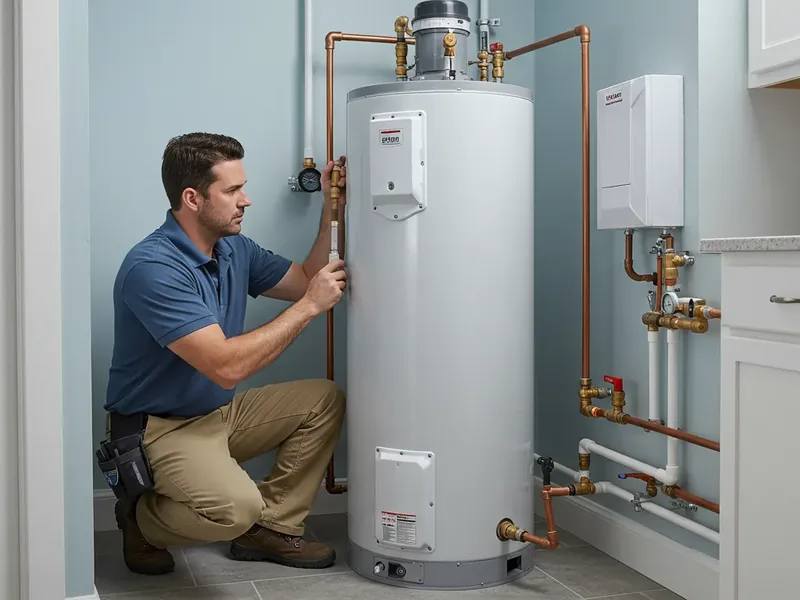
Rusty hot water, rumbling like a freight train, a pilot that won't stay lit, a damp ring at the base that keeps coming back — these are a water heater's resignation letter. In Arcadia, 46030, we read that letter a lot, because hard well water accelerates sediment damage. And once a tank's steel is compromised, replacement isn't the expensive option; it's the only option that doesn't end with 40 gallons on your floor.
Arcadia is a small railroad-era town where early-1900s farmhouses and post-war bungalows sit alongside newer infill homes, with farmland and acreage properties spreading out in every direction. Around Arcadia we find water heaters in basements of the older homes, in utility closets of ranch houses, and occasionally in garages or outbuildings on acreage properties. A proper replacement in Arcadia is more than a tank swap. The new unit has to be sized to your household's actual hot-water demand, matched to your fuel and venting, and brought up to current code — expansion tank on closed systems, proper T&P discharge piping, a drain pan where a leak would cause damage, dielectric unions, and correct gas venting. Water Heater Leak Repair Co. does all of it in a single visit at (833) 713-2101. Old unit hauled away, new unit tested and set to a safe temperature before we leave.
In Short: Don't nurse a dying tank in Arcadia. Call Water Heater Leak Repair Co. at (833) 713-2101 for water heater replacement in 46030 — proper sizing, full code compliance, and the old heater hauled away in one visit, with hot water restored the same day.
How Water Heater Replacement Works in Arcadia, IN 46030
A water heater replacement done right is a six-part job, and the tank swap is only the middle of it. In Arcadia, IN 46030, we follow the same sequence on every replacement because the steps you can't see — sizing math, venting verification, code components — are the ones that determine whether the new unit lasts 12 years or 6:
- Code-required safety components. Expansion tank on closed plumbing systems (required — it absorbs pressure spikes and protects the new tank's warranty), T&P relief valve discharge pipe run full-size to within inches of the floor, proper venting verified with a draft check on gas units, and combustion air confirmed. These aren't upsells; they're what the code — and the manufacturer — require.
- Safe shutdown and drain-down. Gas or power off, water supply closed, and the old tank drained completely through a hose. We also verify the main shutoff actually holds — on older Arcadia homes, original shutoffs sometimes don't, and we deal with that before water is everywhere.
- New unit set and connected. The replacement goes onto a proper pan (new, correctly sized), gets fresh flexible supply lines and a new full-bore shutoff valve, dielectric unions to prevent galvanic corrosion, and correct gas or electrical connections — including a sediment trap (drip leg) on gas units, which many old installs lack.
- Assessment and sizing. We check the old unit's capacity, your fuel type (gas or electric), the venting arrangement, and the physical space — then size the new unit to your household: number of bathrooms, simultaneous uses, and first-hour demand. A family of five and a retired couple don't need the same tank, and guessing here guarantees disappointment.
- Removal and haul-away. The old unit is disconnected — water, gas or electric, venting — and carried out. We haul it away for recycling; you never touch it. This is also when we inspect the platform, the flue, and the surrounding piping for issues the new install must address.
- Fill, purge, test, and set. We fill the tank completely before applying any heat (firing an empty electric unit destroys the elements in seconds), purge air from the lines, relight or re-energize, verify the thermostat setting at a safe 120°F, check every connection for leaks, and walk you through the new unit's operation and maintenance.
One visit, one correctly installed heater, zero callbacks for the things shortcuts cause. If your 46030 tank is done, call (833) 713-2101 and we'll put the replacement on the schedule today.
Warning Signs Arcadia Homeowners Shouldn't Ignore
Your water heater is telling you it's finished when you see these — all common in Arcadia homes:
- Running out of hot water. A tank that used to keep up and now doesn't has lost capacity to sediment or has a failing dip tube or element. If the unit is also old, replacement beats chasing parts.
- Age past 10–12 years. Check the data plate: if your tank is over a decade old in Arcadia's water conditions, it's living on borrowed time. Replacement on your schedule beats replacement after a flood.
- Pilot or ignition problems (gas). Repeated pilot outages, especially with any dampness around the burner, often trace to water intrusion or a failing gas control on an aging unit.
- Rusty hot water (not cold). When only the hot side runs discolored, the tank's interior is corroding. Anode rod replacement can buy time early; once rust is in the water, the end is near.
- Water leaking from the tank itself. Moisture at the base seam, pinholes in the jacket, rust bleeding through — a breached vessel can't be repaired. This is the definitive replace signal.
- Previous repairs stacking up. One valve replacement is maintenance; a valve, then an element, then a thermostat on a 12-year-old tank is good money after bad. We tell Arcadia homeowners plainly when the repair budget should become a replacement budget.
Arcadia's Local Factors: Water, Homes, and Climate in 46030
Well water on the outskirts of Arcadia tends to be very hard, which accelerates sediment buildup inside tanks. Older farmhouses often still have galvanized supply nipples that corrode from the inside out, creating leak points at the top of the tank that are easy to mistake for tank failure. The rest of the local picture matters too. Arcadia is a small railroad-era town where early-1900s farmhouses and post-war bungalows sit alongside newer infill homes, with farmland and acreage properties spreading out in every direction. Around Arcadia we find water heaters in basements of the older homes, in utility closets of ranch houses, and occasionally in garages or outbuildings on acreage properties. Here's what those Arcadia realities mean for your replacement:
- Hard water shortens tank life here. Homes inside town run on municipal water, but many properties just outside the town limits rely on private wells pulling hard groundwater from limestone aquifers. In Arcadia, sediment buildup is the number-one tank killer, which is why we talk anode rods and flushing schedules with every replacement — the new tank should outlive the old one, not repeat its fate.
- Winter changes the calculus. Many Arcadia-area homes still heat with older atmospheric-vent gas units tucked into basement corners with limited clearance. Cold incoming water in January makes undersized tanks run out faster and works recovery harder. We size Arcadia replacements for real winter conditions, not just the nameplate rating.
- Venting must match the home. Arcadia is a small railroad-era town where early-1900s farmhouses and post-war bungalows sit alongside newer infill homes, with farmland and acreage properties spreading out in every direction. Atmospheric-vent units need a proper draft up a flue; power-vent units need electrical and PVC venting routes. We verify what your home actually supports before recommending a unit — the wrong venting choice is dangerous, not just inefficient.
- Placement affects the install. Around Arcadia we find water heaters in basements of the older homes, in utility closets of ranch houses, and occasionally in garages or outbuildings on acreage properties. Tight closets, low basements, and crawlspaces each demand specific clearances for service access and combustion air. We measure twice, because a unit that can't be serviced is a unit that won't be maintained.
- Closed systems need expansion tanks. Many Arcadia homes have pressure-reducing valves or backflow preventers that create closed plumbing systems — and on a closed system, thermal expansion has nowhere to go without an expansion tank. We install one with every replacement that needs it; skipping it voids warranties and weeps relief valves.
What makes Arcadia distinct for replacements: Many Arcadia-area homes still heat with older atmospheric-vent gas units tucked into basement corners with limited clearance.
What Happens When You Call Water Heater Leak Repair Co.
No phone trees, no pushy sales visit — here's exactly what happens when Arcadia homeowners call (833) 713-2101:
- 1. You tell us the symptoms. Age of the unit, what's going wrong, where it sits. We'll give you an honest read on repair versus replacement over the phone and schedule the visit — same-day in most of Arcadia.
- 2. We confirm and size on site. Our technician verifies the tank's condition, measures the space, checks fuel and venting, and sizes the replacement to your household's real demand. You approve the plan before any work starts.
- 3. We install, test, and haul away. Old unit out and recycled, new unit installed to code with all safety components, filled, tested, and set to 120°F. Hot water back the same day, and you know exactly how to maintain it.
Stop budgeting around a tank that's already failed. One call to Water Heater Leak Repair Co. at (833) 713-2101 brings Arcadia a complete replacement — correct sizing, full code compliance, same-day hot water, and the old unit gone. Arcadia, IN 46030: let's put this one behind you.