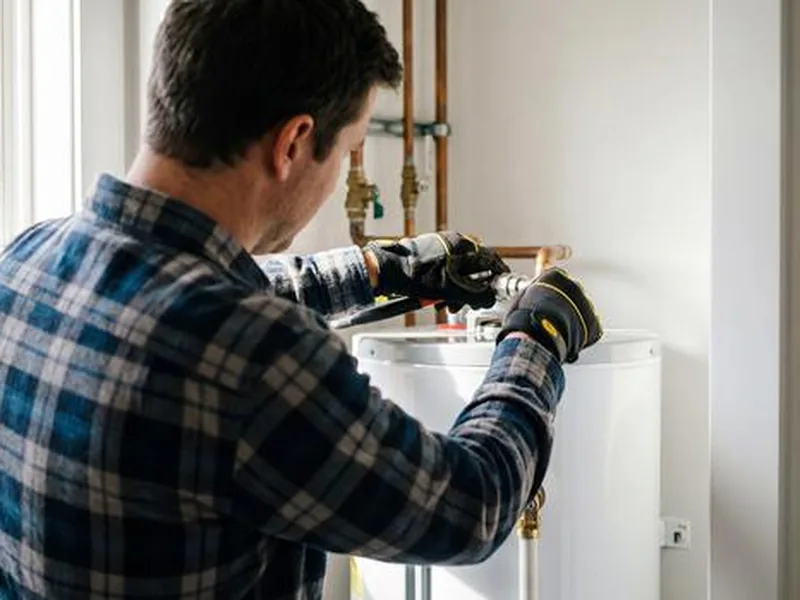
Every water heater has an expiration date stamped into its steel — usually 8 to 12 years in central Indiana, less when hard water and heavy use gang up on it. When the tank itself fails — a split seam, a rusted-through base, a pinhole that becomes a stream — there's no repair that holds. Patch compounds and sealants can't restore structural steel, and a patched tank is a flood waiting for a moment. Replacement is the honest fix: the old unit comes out, a correctly sized new unit goes in, and everything the current code requires comes with it.
Fishers has boomed into a large, affluent suburb northeast of Indianapolis, with Geist Reservoir to the east and big two-story family homes across master-planned neighborhoods. Municipal water serves Fishers homes; it is moderately hard central Indiana water that builds sediment in hardworking family tanks. Those two facts decide a lot about replacement in Fishers: how long tanks last here, what venting and placement the new unit needs, and which code upgrades apply. Water Heater Leak Repair Co. handles the whole job for Fishers, IN 46038 — sizing, fuel type, venting, expansion tank, drain pan, T&P discharge, permits where required, and haul-away of the old unit. Call (833) 713-2101 and get hot water back without the guesswork.
In Short: If your water heater in Fishers, IN 46038 is over 10 years old, leaking from the tank, or running out of hot water, call Water Heater Leak Repair Co. at (833) 713-2101. We size and install a code-ready replacement — usually the same day — and haul the old unit away.
How Water Heater Replacement Works in Fishers, IN 46038
Here's exactly what happens when Water Heater Leak Repair Co. replaces your water heater in Fishers. Big households mean big hot-water demand, and Fishers tanks work hard: heavy use plus moderately hard water equals fast sediment buildup and shorter tank life. With so many finished basements, we always evaluate leak containment — a pan, a drain, and an alarm — on every visit. No surprises, no shortcuts — just the complete job:
- Assessment and sizing. We check the old unit's capacity, your fuel type (gas or electric), the venting arrangement, and the physical space — then size the new unit to your household: number of bathrooms, simultaneous uses, and first-hour demand. A family of five and a retired couple don't need the same tank, and guessing here guarantees disappointment.
- Code-required safety components. Expansion tank on closed plumbing systems (required — it absorbs pressure spikes and protects the new tank's warranty), T&P relief valve discharge pipe run full-size to within inches of the floor, proper venting verified with a draft check on gas units, and combustion air confirmed. These aren't upsells; they're what the code — and the manufacturer — require.
- Removal and haul-away. The old unit is disconnected — water, gas or electric, venting — and carried out. We haul it away for recycling; you never touch it. This is also when we inspect the platform, the flue, and the surrounding piping for issues the new install must address.
- Safe shutdown and drain-down. Gas or power off, water supply closed, and the old tank drained completely through a hose. We also verify the main shutoff actually holds — on older Fishers homes, original shutoffs sometimes don't, and we deal with that before water is everywhere.
- New unit set and connected. The replacement goes onto a proper pan (new, correctly sized), gets fresh flexible supply lines and a new full-bore shutoff valve, dielectric unions to prevent galvanic corrosion, and correct gas or electrical connections — including a sediment trap (drip leg) on gas units, which many old installs lack.
- Fill, purge, test, and set. We fill the tank completely before applying any heat (firing an empty electric unit destroys the elements in seconds), purge air from the lines, relight or re-energize, verify the thermostat setting at a safe 120°F, check every connection for leaks, and walk you through the new unit's operation and maintenance.
Most Fishers replacements are done in three to five hours — hot water back the same day, old tank gone, everything to code. That's what (833) 713-2101 gets you.
Warning Signs Fishers Homeowners Shouldn't Ignore
Your water heater is telling you it's finished when you see these — all common in Fishers homes:
- Rusty hot water (not cold). When only the hot side runs discolored, the tank's interior is corroding. Anode rod replacement can buy time early; once rust is in the water, the end is near.
- Age past 10–12 years. Check the data plate: if your tank is over a decade old in Fishers's water conditions, it's living on borrowed time. Replacement on your schedule beats replacement after a flood.
- Water leaking from the tank itself. Moisture at the base seam, pinholes in the jacket, rust bleeding through — a breached vessel can't be repaired. This is the definitive replace signal.
- Pilot or ignition problems (gas). Repeated pilot outages, especially with any dampness around the burner, often trace to water intrusion or a failing gas control on an aging unit.
- Running out of hot water. A tank that used to keep up and now doesn't has lost capacity to sediment or has a failing dip tube or element. If the unit is also old, replacement beats chasing parts.
- Rising energy bills. A sediment-choked tank burns more fuel for less hot water. When the gas or electric bill climbs and the showers get shorter, the heater is telling you its efficiency is gone.
Fishers's Local Factors: Water, Homes, and Climate in 46038
Big households mean big hot-water demand, and Fishers tanks work hard: heavy use plus moderately hard water equals fast sediment buildup and shorter tank life. With so many finished basements, we always evaluate leak containment — a pan, a drain, and an alarm — on every visit. The rest of the local picture matters too. Fishers has boomed into a large, affluent suburb northeast of Indianapolis, with Geist Reservoir to the east and big two-story family homes across master-planned neighborhoods. Fishers heaters typically sit in basement utility rooms — frequently next to finished basements — or in garages in slab sections. Here's what those Fishers realities mean for your replacement:
- Venting must match the home. Fishers has boomed into a large, affluent suburb northeast of Indianapolis, with Geist Reservoir to the east and big two-story family homes across master-planned neighborhoods. Atmospheric-vent units need a proper draft up a flue; power-vent units need electrical and PVC venting routes. We verify what your home actually supports before recommending a unit — the wrong venting choice is dangerous, not just inefficient.
- Closed systems need expansion tanks. Many Fishers homes have pressure-reducing valves or backflow preventers that create closed plumbing systems — and on a closed system, thermal expansion has nowhere to go without an expansion tank. We install one with every replacement that needs it; skipping it voids warranties and weeps relief valves.
- Placement affects the install. Fishers heaters typically sit in basement utility rooms — frequently next to finished basements — or in garages in slab sections. Tight closets, low basements, and crawlspaces each demand specific clearances for service access and combustion air. We measure twice, because a unit that can't be serviced is a unit that won't be maintained.
- Hard water shortens tank life here. Municipal water serves Fishers homes; it is moderately hard central Indiana water that builds sediment in hardworking family tanks. In Fishers, sediment buildup is the number-one tank killer, which is why we talk anode rods and flushing schedules with every replacement — the new tank should outlive the old one, not repeat its fate.
- Winter changes the calculus. Many Fishers homes run 50-gallon or larger units to keep up with multiple bathrooms, and those bigger tanks hold more water when they fail. Cold incoming water in January makes undersized tanks run out faster and works recovery harder. We size Fishers replacements for real winter conditions, not just the nameplate rating.
The Fishers spotlight for replacement: Many Fishers homes run 50-gallon or larger units to keep up with multiple bathrooms, and those bigger tanks hold more water when they fail.
What Happens When You Call Water Heater Leak Repair Co.
No phone trees, no pushy sales visit — here's exactly what happens when Fishers homeowners call (833) 713-2101:
- 1. You tell us the symptoms. Age of the unit, what's going wrong, where it sits. We'll give you an honest read on repair versus replacement over the phone and schedule the visit — same-day in most of Fishers.
- 2. We confirm and size on site. Our technician verifies the tank's condition, measures the space, checks fuel and venting, and sizes the replacement to your household's real demand. You approve the plan before any work starts.
- 3. We install, test, and haul away. Old unit out and recycled, new unit installed to code with all safety components, filled, tested, and set to 120°F. Hot water back the same day, and you know exactly how to maintain it.
Stop budgeting around a tank that's already failed. One call to Water Heater Leak Repair Co. at (833) 713-2101 brings Fishers a complete replacement — correct sizing, full code compliance, same-day hot water, and the old unit gone. Fishers, IN 46038: let's put this one behind you.